from 0 review
12 Nights 13 Days
Daily Tour
12 people
___
The adventure begins at the town of Manali, a very well-liked and easily accessible tourist destination.
The first half of the day is spent getting acquainted with one another and the mountain air.
At night, spend your time taking proper rest and relaxing your bodies as the trek starts tomorrow.
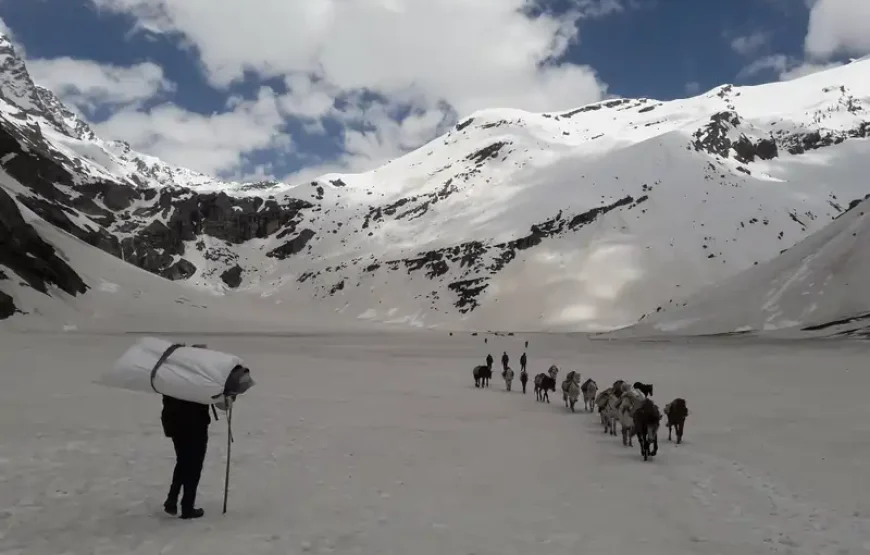
Today, we'll be travelling to Chhikka's vast fields.
We will need to drive up to the trailhead, Khanol, which is where the Duhangan Hydro Project is located
The journey up 40 hairpin curves takes you to Khanol.
The hike along the Jagatsukh Nala through forested terrain from Khanol to Chhikka is brief and delightful.
Reach your campsite and unwind for the rest of the day. Spend the night there at campsite.
Today, after breakfast, we at 9 AM. Along the Jagatsukh Nala
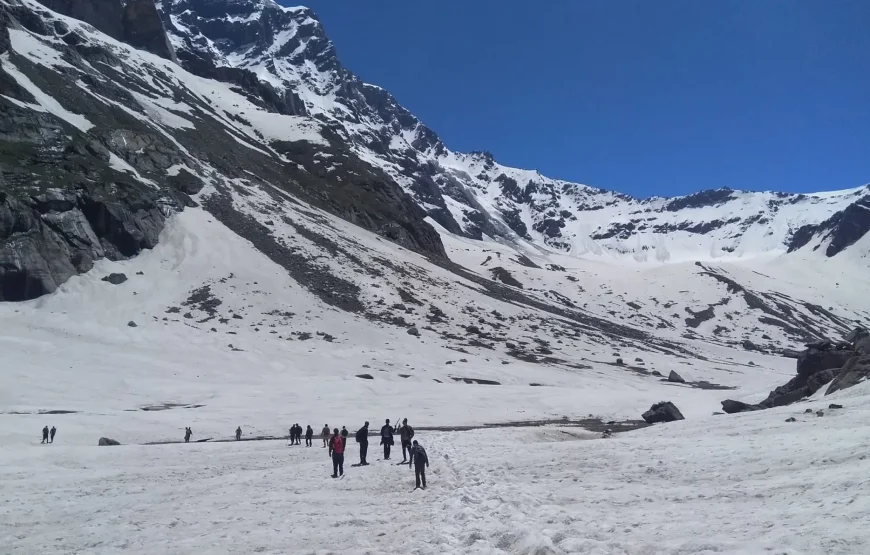
The ascent from 3,175M to 3,700M is gradual.
The Tanita cliffs, which tower to the left and have waterfalls tumbling on the rocks below,
Spend the night camped on the flatlands. The dome of Deo Tibba will be visible for the first time at this time.
Between 9 and 10 AM, we set out across Seri's level meadows, followed by a stream crossing.
Today's hike is more difficult, starting on a level path across the Seri grasslands.
Continue along the Jagatsukh River, encountering a waterfall and a nearby boulder.
After crossing the river, ascend a steep, zig-zag trail to Tainta Cliff for 2-2 1/2 hours.
The two-hour ascent leads to Chota Chandratal, a small lake where the campsite is located in a closed valley.
Get up this morning and relax. It's critical to give your body enough time to acclimatise considering that we have ascended to 4200 metres in elevation.
You increase your chances of getting altitude sickness if you are increasing altitude quickly and do not plan enough time to acclimatise.
This encourages the physiological adjustments your body has to make to the environment and the lower oxygen intake at higher elevations.
Also, inform your trek leader right away if you exhibit symptoms of AMS.
There will be briefings on the summit procedure and upcoming events in the evening.
Mountaineering starts today.
A load ferry is crucial when mountaineering.
Take the appropriate acclimatization steps
You will transport your belongings to camp 1 today and return to base camp for the night.
The terrain is challenging and begins with a 200 m moderate incline before becoming steep for 300 m, then flat for 100 m.
The location of Camp 1 is on Duhangan Pass.
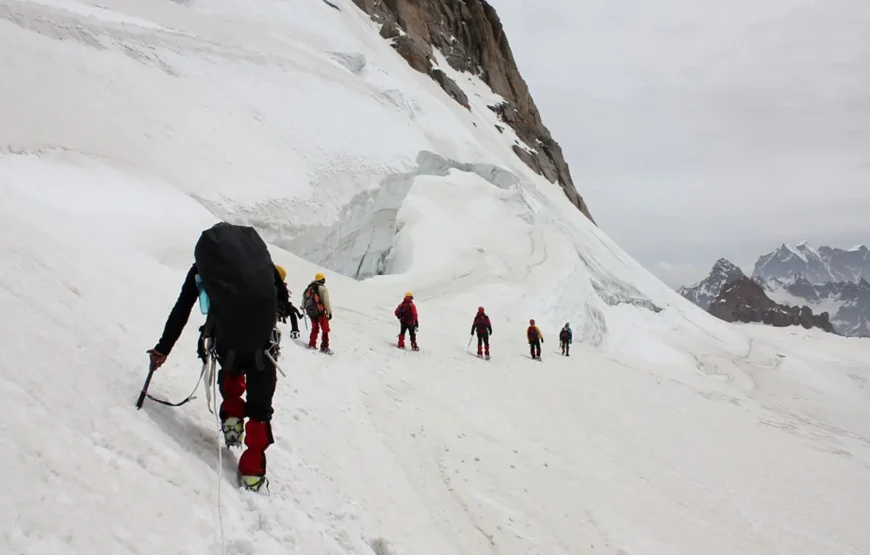
Watch your steps because the glacier has a lot of crevasses.
After you've loaded everything, eat lunch at camp 1 and get ready to descend. Tents will be used for lodging at Base Camp.
Your official transition to camp 1 will take place today. The path you took yesterday is what you should take today.
Be careful when crossing rocks and in areas where there are rockfalls and glaciers.
The ascent will take roughly 5 to 6 hours. Make sure to rest adequately and avoid overworking your body. Once you reach camp 1, stay in tents.
Move on up to the highest camp now. However, it will just be loading the ferry and returning to Camp 1.
The load ferry concept is used once more to avoid altitude-related problems and to assist your body acclimatize to the shortage of oxygen because altitude-related sickness is a possibility as we are gaining quite a deal of height in a short period of time.
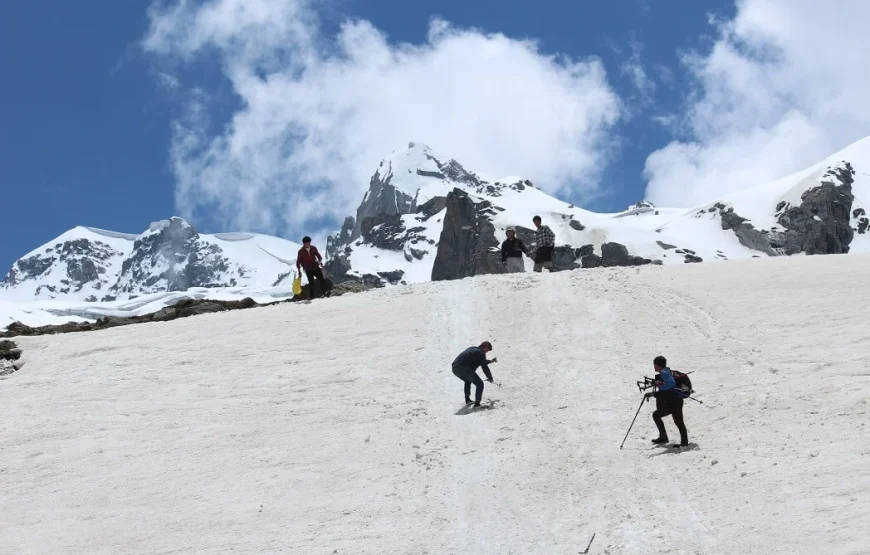
Snow covers the entire trail on today's trek. Therefore, it is vital to wear all of your snow gear and clothing. The trail is significantly more challenging because of the snow.
For the first one hour, it is a moderate climb which later on becomes a steep climb. Follow the footsteps of your guide as he breaks the route open for you.
Spend little time on the summit camp, and have lunch so that your body starts acclimatising. Again retrace your steps back to camp 1. Stay the night in Camp 1 and rest your body well.
The entire team is headed to summit camp today. Bring only what you will actually need and leave the rest at camp 1.
We visit the campgrounds twice for Deo Tibba: once during the load ferry when we carry our belongings to Camp 1 and then back to the lower campsite, and once between Camp 1 to the summit camp and then back to Camp 1.
This offers many advantages. To avoid having to carry a heavy load throughout the walk, you first divide the weight between two days.
Finally, every time you climb the same route, it gets easier and you get better at using your techniques and talents. This provides your body enough time to acclimatise to the high altitude conditions.
Your crew will give you a summit attempt briefing once you get to the camp. It's an excellent opportunity to review your knowledge of snow and ice.
The summit night will make for a spectacular evening. For the summit attempt, have a filling meal and get enough sleep.
At two in the morning, the summit attempt will begin. To prepare for the summit push, get up at the appropriate time. The trek begins by using fixed ropes to bridge a gulley.
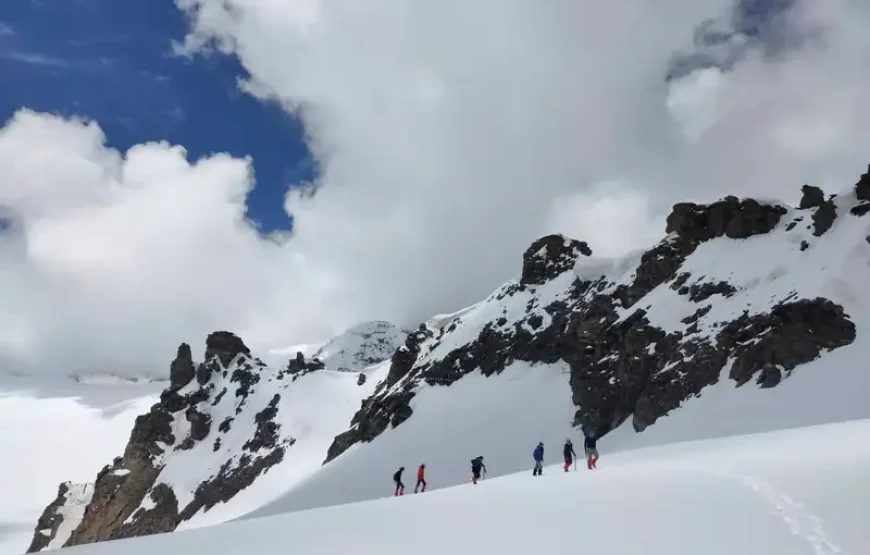
The rise in the first 300 metres is difficult and steep. Continue ascents up the snowy mountains. As you ascend, you can view the Indrasan Peak.
Just before the top, the slope becomes steeper. Actually, the summit is a huge snow dome that is open and level. As a result, the final 100 metres to the summit are practically level.
Near the conclusion, there are a lot of crevasses as well. While navigating the gully and ascending to the summit is doable, the main difficulty is breathing in the increasingly thin air as you continually ascend.
The summit is spacious enough to fit the entire squad. You can clearly see the Indrasen peaks and a mountain lake when you reach the summit. The vistas are simply breathtaking.
After attempting the summit, stay a little while there, celebrate your success, and then return to camp 1.
It's time to begin the return trek after the summit attempt. To go to Deo Tibba Base Camp, stay on the same trail.
Be careful when you descend because it is steep. Be cautious and keep a steady pace as you descend because it can be hard on your knees.
Try to arrive at the Base Camp before noon. Your Trek Leader should receive all of your technical gear back. After an eventful day, relax in your tents.
Start your journey home again. Trek backwards through the rocky moraines and steep slopes. Between turns, the path is flat and inclining.
In essence, you'll be returning to the same set of stairs. Since the walk is 14 km long, bring a packed lunch. Enjoy your final camping trip at Chhikka.
The trek's final day has come. On the final day, you must retrace your travels using the very first path that you devised.
Gather all your memories, then bid the mountains farewell. Ride back to Manali after reaching Khanaul via the same trekking route.
You will arrive in Manali around lunchtime after a couple hours of driving and the accompanying trek. Have a happy celebration of your success and a safe trip home!

Leave a Reply